
What Fiction Writers Ought to Know About Libel
- 1 day ago
- 9 min read

Introduction
One of the most common pieces of writing advice is deceptively simple: Write what you know.
For many writers, that means drawing from real life. We borrow mannerisms from friends. We "steal" snippets of conversation overheard in coffee shops. We build characters from old teachers, former coworkers, difficult relatives, and people we met exactly once but never forgot.
Reality is often where fiction begins. The problem is that reality doesn't always stay in the background. At some point, nearly every writer hears a version of the same question:
"Is this storyline about [redacted person]?"

Sometimes the answer is no. Sometimes it's complicated. Sometimes the writer suddenly realizes that the character they thought was fictional may be far more recognizable than they intended.
This is where discussions of libel usually begins. Fortunately, most fiction writers will never face a libel claim. So I ask you, dear reader: How close is “inspired by” allowed to get before it becomes legally risky?
Table of the Contents
Section 1: What Libel Actually Means for Fiction Writers
Libel is a written false statement that harms someone's reputation. It's different from slander in that slander is about spoken false statements that harm someone's reputation.
For fiction writers, three ideas matter most:
Identification: Can someone reasonably identify the real person?
Defamation: Does the portrayal harm reputation?
Falsity: Would readers interpret the portrayal as describing real facts about that person?
Notice what's missing from that list: intent.
A writer can genuinely believe they have created a fictional character and still find themselves facing questions about whether a real person is recognizable on the page.
Fiction is not automatically protected simply because "it is fiction." The question is not whether you intended to write about a real person. The question is whether or not readers think you did.

Section 2: Identification (or The “Invisible Name Tag” Problem)
By all means, stay true to the source. My whole brand is about getting those authentic details for your stories. The danger zone here isn't about realism. Libel for fiction writers is about traceability. Most writers assume identification requires a name. Nope!
A character becomes “identifiable” and "traceable" when multiple anchors align:
Job + location + timeline match a real person
Unique quirks (speech patterns, habits, backstory)
Social network overlap (“everyone in that circle knows”)
Imagine a novel set in a small town. One character is:
The only veterinarian in town
Known for raising alpacas
Recently divorced
Ran unsuccessfully for city council
Writers often focus on obvious identifiers while overlooking the cumulative effect of smaller details. A profession might not identify someone. A profession plus a location might. Then add a timeline, a personal habit, and a recognizable life event? Suddenly the character begins to point toward a specific individual.
For example:
"Character A":
Works at a specific small-town newspaper
Recently divorced
Known for a specific catchphrase or behavior
Even if unnamed, readers in that community may directly map it to a real journalist. And the argument of "nobody outside of my town will know" fall flat when the audience that matters is a workplace, church, school, or local community. Not the general public.
"Character B":
Works as the only pediatric nurse practitioner in a mid-sized suburban clinic
Known for never taking lunch breaks and eating granola bars while charting
Drives a distinctive bright yellow compact car with a bumper sticker about books
Recently involved in a public workplace conflict over scheduling changes
Even without a name, coworkers, patients, or parents in that clinic’s orbit could quickly narrow this down to one person if the combination is distinctive enough in their shared environment.
"Character C":
High school theater director in a small school district
Famous for insisting every production include at least one “unexpected” casting choice
Always ends rehearsal by clapping twice and saying the same short phrase
Previously directed a regional competition-winning musical that local news covered
Lives in the same town where they teach and often appears at school events outside work hours
Here, identification becomes even easier because multiple public-facing touchpoints (school + media coverage + repeated behavioral pattern) reinforce the real-world mapping effect.
Problems tend to arise when writers stop collecting details and start reconstructing individuals. One is inspiration. The other is replication.
Think of identification less as a single clue and more as a constellation.
One star means very little, but ✩₊⁺⋆₊✧ enough stars arranged in a pattern becomes an unmistakable correlation. ✩₊⁺⋆₊✧
Section 3: “It’s Fiction” Is Not a Shield
Disclaimers don’t override identifiability.
I dearly adore fanfic writers and YouTube essayists and all that they do but "no copyright infringement intended💚" carries quite literally no legal weight. I have some thoughts on working some witchcraft for your writing but, under no circumstances, is
"Under U.S. copyright law, fair use is an exception to the exclusive rights held by a copyright owner. It allows limited use of copyrighted material without permission in certain contexts, such as criticism, comment, news reporting, teaching, scholarship, or research. Whether a specific use qualifies as fair use is determined on a case-by-case basis by weighing several factors. These include the purpose and character of the use, such as whether it is commercial or nonprofit educational; the nature of the copyrighted work itself; the amount and substantiality of the portion used in relation to the whole work; and the effect of the use on the potential market for or value of the original work. Importantly, the fact that a work is unpublished does not automatically prevent a finding of fair use, but it is still considered as part of the overall evaluation of these factors."
a protective spell.
Disclaimers can communicate intent, but they don't erase recognizability.
"Any resemblance to actual persons, living or dead, is purely coincidental." is seen in many upon many books. However, if readers can reasonably identify a real person and believe the story is making unfair factual claims about them, the disclaimer is unlikely to be the deciding factor.
The same principle applies outside the manuscript.
Authors occasionally strengthen identification without realizing it through interviews, social media posts, newsletter updates, or conversations at events.
The more a writer publicly discusses who inspired a character, the easier it may become for readers to connect the dots.
There are a few well-known cases where authors have effectively “collapsed the distance” between fiction and real-life inspiration through interviews, essays, or public commentary—sometimes intentionally, sometimes not.
Let's consider The Devil Wears Prada by Lauren Weisberger. While the novel is fictionalized, readers and critics quickly noticed strong parallels between the character Miranda Priestly and Vogue editor-in-chief Anna Wintour. At first, the connection was mostly speculative, grounded in the author’s former role and the novel’s detailed depiction of a demanding fashion magazine environment. However, in interviews and public commentary, Weisberger and others associated with the story acknowledged aspects of real-life inspiration, reinforcing what audiences already suspected.
Over time, those remarks (combined with widely discussed similarities between real and fictional figures) helped solidify the association in public perception, contributing to debate about how closely fictional characters can resemble real individuals without explicitly naming them.
More over, the more a story is “sold” as inspired by reality, the less protective the fiction label becomes.

Section 4: The Amplifiers of Accusation
Not every recognizable character creates problems. Even Anna Wintour can get a laugh out of her role of inspiring The Devil Wears Prada. To say, "it's fine because it's true," isn't true. Truth can be a defense against libel, but rumors, assumptions, and personal memories are not the same thing as verifiable facts. Risk generally rises when fiction attributes serious wrongdoing or serious falsities to someone that readers can identify.
Examples might include:
Corruption or bribery (especially in public office or corporate leadership)
Sexual misconduct (beyond harassment, including coercion or assault allegations)
Discrimination or hate-based behavior (racism, sexism, antisemitism, etc.)
Financial crimes beyond fraud (embezzlement, money laundering, insider trading)
Endangerment or negligence (causing harm through reckless professional conduct)
Abuse of power or authority (misuse of institutional position for personal gain)
Sabotage or intentional wrongdoing in a workplace or organization
Treason or betrayal of an organization, state, or group
Cover-ups or obstruction of justice (hiding wrongdoing or interfering with investigations)
False medical or scientific conduct (misdiagnosis, falsified research, unethical experimentation)
Blackmail or coercion
Exploitation (financial, emotional, or professional exploitation of others)
Criminal conspiracy or association with criminal networks
Perjury or lying under oath (or implied dishonesty in formal settings)
Substance abuse portrayed in a way that implies real-life irresponsibility in professional contexts
Once a reader successfully maps a fictional character onto a real individual, the interpretive process can shift from “this is inspired by” to “this is revealing.” At that point, narrative details are often re-read as evidentiary rather than imaginative. Even elements that were originally intended as exaggeration, thematic symbolism, or composite construction may be retrospectively treated as disclosures about the real person’s behavior or character.
This can lead to a form of “confirmation bias reading,” where readers selectively interpret ambiguous or general traits as supporting evidence of a pre-existing identification. Once the mental link is established, neutral or fictionalized behaviors in the text may be reframed as indirect admissions, while coincidences are treated as corroboration rather than chance or genre convention.
In more extreme cases, readers may begin to treat the fictional work itself as a semi-documentary source, attributing higher credibility to the narrative than to any disclaimers, interviews, or authorial intent. This is especially likely when the author has discussed inspiration publicly, because even vague acknowledgments can be reinterpreted as partial confirmation of all inferred details.
As a result, the boundary between narrative construction and perceived factual reporting becomes unstable: the story is no longer read purely as fiction, but as a coded account of real-world conduct, with readers effectively “upgrading” implication into perceived fact.
Section 5: The Fiction Writer's Best Defense
The safest and most creatively rewarding approach (preferably before publication) is often one in the same:
📣📢CHANGE IT📢📣
Get those creatives juices flowing again, friend. Edit the architecture of the character. Instead of building a character from one person, build them from two—three—five! Learn from different personalities and introduce different traits. Change their occupation. Their partner's type. Explore more of the earth and move the story setting elsewhere! Change the order of events.**
**Caveat to the instructions: Your mileage will vary. If it's a workplace romance, probably don't change the job. If it's based on a historical location, keep the story there and change other things. If the timeline super duper matters, throw things off with other tactics.
You'll ultimately want to ask yourself these three questions:
Could someone who knows the real person recognize them in this character?
Could a stranger reasonably infer this character is based on a specific real person?
Does the character contain any direct real-world anchors (name, job, place, timeline, or anecdote) that point to one identifiable individual?
Do multiple details combine into a traceable match to a specific real person or incident?
And if the answers to all four are NO, you're generally in the clear from a recognizability standpoint. (This is where I disclose that I am not a legal advisor 😬)
And look at the silver lining: a transformed character can become stronger because of this care!! A copied person is limited by reality. You spin the tale of your character and can reach no bounds. (!!)
Don't hide your source material. That's not what this is about. The goal is to create something new enough that the source material no longer matters.


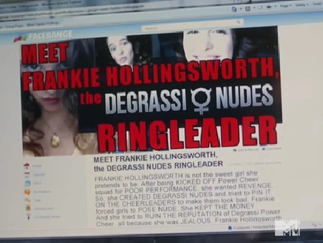
The above photos are from Degrassi's version of Facebook called Facerange. The platform was often used to spread libel
Conclusion
Fiction doesn’t get into trouble for being inspired by reality. The trouble starts when reality is still intact on the page.
Writers often worry that changing too much will make a story feel less authentic.
In practice, the opposite is usually true: Observation creates the authority but it's the writer's transformation of what is observed that creates such lovely fiction.
The details we collect from the real world are valuable because they help us understand how people speak, work, grieve, celebrate, avoid questions, tell stories, and otherwise reveal themselves. But our job as writers is not to reproduce those people exactly as we found them. We must build something new from what we've learned. You want a transformation of reality instead of a roadmap that points back to it.
When a character can no longer be reliably reverse-engineered into a single person, when their traits no longer converge into a recognizable silhouette, they become fully fictional in the only way that matters for writers: independent, self-contained, and no longer dependent on their origin story.
Don't disguise what's real, rebuild the reality entirely and the character becomes free. Legally safer. Narratively stronger. No longer tethered to the logic of any one life. Able to behave in ways that real people rarely can, or would.
It becomes something that only exists because you rebuilt it.
How thrilling,
Katherine Arkady


Comments