
From the Source: Cultivating Patience with Gardeners
- Jun 12, 2025
- 9 min read

Introduction
“Flowers are restful to look at. They have neither emotions nor conflicts.” —Sigmund Freud
But the emotions and conflicts in getting to that bloom are the opposite of restful.
Yes, gardening, the "easy-going" past time of the silver-haired neighbors in those "easy-going" Hallmark movies. Same sort of energy as the "easy-going" writers having a burp of writer's block while writing their immediate Best Seller novel.
AS IF
Readers, I am always one to suggest doing research for your writing. I was working on a character who worked as a gardener. I had a green thumb from my mother, but I felt I needed more knowledge on flora to properly write about my dear Helene.
Where does one study gardening? There are, admittedly, many avenues. The avenue I took was through the extension program of Michigan State University. Because MSU is an agricultural college—more specifically the first agricultural college in the United States when it was originally known as the Agricultural College of the State of Michigan—it's their goal to "disseminate information from university research to communities on subjects like agriculture."
I took online classes over twelve weeks. This instruction was given by my area MSU Extension Consumer Horticulture Educator with 25+ peers. We studied soil science, fruiting trees and vegetables, perennials, annuals, shoreline environments, composting, integrated pest management and a whole lot else.
If you have the interest in learning more about gardening, volunteering in your community, and becoming closer with the natural world, I highly recommend you reach out to your local extension office to learn more. You learn more about the earth and, in turn, you learn more about yourself. The gardening community is generous and always willing to answer my many, many, many questions.
And it's not just Michigan. There are Extension Master Gardener programs all over the United States!
After taking the course, passing the final test, and volunteering for 40 hours in my community's gardens, I became a Certified Master Gardener. After volunteering 100+ hours, I am now a Certified Advanced Master Gardener. I dare say that I know my stuff.
But here's my hang up: there's a huge difference between knowing a whole bunch of stuff and knowing how to implement a whole bunch of stuff. I wanted to be a perfect gardener doing everything right on the first go. I wanted to have a perfect garden my first season. Just like I want to be a writer doing everything right on the first go with a perfect novel in my first year of writing.
AND THAT WASN'T HAPPENING 😩😩😩
I had to sit myself down and ask a very annoying question: How can I cultivate the patience to complete all of this?
I reached out to my fellow extension Master Gardeners to get their opinions.

The Slow Magic of Growth
I've gardened through many seasons with Carolyn and Darlene. Like many of the volunteer gardeners, they have become excellent mentors. They know how gardens change over the years and they know the character building work that gardens take out of you.
Above all, they know about the slow magic of growth.
I asked them, "Gardening requires a lot of time before you see results. What helps you stay motivated when progress isn’t visible yet?"
Darlene had this to say:
I’m fortunate to have plants in all different stages of growth/progress (sleep, creep & leap—and, of course, there’s always dead), so my garden is always changing & evolving. Progress to me could be no invasives in my bed this year which would only be visible to me.
Sharing the joy I feel when I’m successful. Whether seeds, plants, veggies/fruits, “how-to's” that worked for me, pictures of my progress, or a slow walk through my garden with a friend/fellow gardener/grandchildren.
Constantly adding something new, exciting or challenging—such an a new plant, a new method of propagation, or overwintering.
Carolyn offered this:
Talking to other gardeners, taking care of existing plants and educating myself about all the benefits of gardening... its a process and an experiment.
Growth is slow. That's not a flaw. It's just the way that it is.
Ugh, I know. You work on your drafts and work on your weeding and work on your query letter and work on your tomato plants and work some more on finding agents asking for something remotely like your story and don't see immediate results. You have to practice utmost faith that your efforts will pay off.
However, without seeing results, motivation can certainly shrivel up. I know this because I've had a Menty B or two (or four) about pitching to 40+ literary agents, making edits on my manuscripts, and trying for a social media platform. (And about my perennials coming back the next year after super sun damage because I planted it in the wrong spot the year before, but that's still a soft spot. RIP coral bells.)
Carolyn and Darlene know the importance of setting the tone first. Goals can be large like a vegetable garden overhaul. They can be as manageable as ensuring there are no invasive plants in your garden. Us writers can do the same by setting the tone for our goals. The goal can be as large as finishing a manuscript in six months to as manageable as writing one (1) page each day.
Darlene's advice to "take a slow walk through my garden with a friend/fellow gardener/grandchildren" cannot be overstated. As the circa-1930s proverb says, "A problem shared is a problem halved." Having community to share your bountiful garden with is healing. Having community to share your bountiful prose with is a great way to give you more space to EXIST. You'll be able to approach your goals in a calmer way with more space to process struggles.
Remember this always: gardens eventually display progress. You see the sprouts erupt from the ground and climb up a trellis to reach the sun before it fruits.
Writing progress? That is a liiittle harder to see. Being published at any point isn't assured like a healthy tomato is come September. After a load of work behind you and no offers ahead, there gets to be a point when you're questioning if you've done anything at all.
The progress and action starts to happen in the roots. Deep in the dirt. Where you can't see much. Writing habits need to be set. Roots need to establish. As wise Qveen Herby says in her song "Mission": Gotta get the roots 'fore you get the fruit. I'll take this time to recommend Qveen Herby YET AGAIN for getting yourself to the ultimate level of Bad Bitchery.
Your writing progress may still be in the roots but there is still action happening there.
Just like Carolyn said, "its a process and an experiment." There's no one right way to garden. There's no one right way to write—if there was, that person would be rich.
Failure isn't the end, either, it's just a learning opportunity. When you know more from Experiment #1, you can use that knowledge to set yourself up better for Experiment #2. Keep track of your work with a "Done List" or a proof-of-competency list, if you will, to remind yourself of what efforts you have put into the roots.

Routine Care, Not Constant Output
Sometimes, it's not about the harvest. Sometimes, it's not even about the growth. Paramount to all of this is the care. I'm talking quiet, consistent tending that happens even when nothing exciting is visible.
Watering. Reading.
Checking leaves. Checking typos.
Watching for pests. Watching for literary scams.
Turning the soil. Turning the pages of a potential comp title.
Adjusting a pot just slightly so it gets better light. Adjusting your query letter ever so slightly so it has more punch.
Again, you're not sure anything is going to come from the results. Outcomes are really difficult to predict. Efforts can be made, but the universe may have other plans. How do you stay patient with the unpredictability of it all?
I asked the gardeners: "Has gardening taught you anything about working with (rather than against) uncertainty—like unpredictable weather or slow growth?"
Carolyn:
Life can be much like growing plants, you have to find out the background and needs of the plants (or project), check for optimal conditions as much as possible, trust that growth is happening although it may begin slowly.
You can’t yell at a seed to hurry up. You can’t flood it with water once and expect it to thrive. Care is cumulative. So is your creativity as a writer.
Soil or story—nothing thrives when it’s rushed. You c̶a̶n̶'t̶ shouldn't force yourself to create big changes when gentle tending and the completion of small tasks will also get you to a goal. Like the Motivational/Peak Performance/Fear Elimination/High-Performance/Abundance Mindset/Empowerment Coaches always say: micro changes make macro results.
Darlene:
I’m more successful & work is easier if I don’t ignore or fight Mother Nature.
For instance, using a majority of native plants—strong, deep roots that can withstand the changing weather conditions, pests, and diseases. Also, how past practices (disease, pest, invasive management, non natives…) have ruined the balance of Mother Nature.
I try to focus on one day/week at a time and one or two tasks at a time. Like pruning all the roses, fertilizing, dividing plants, or one bed/area at a time. This usually gives me a good visual of progress and allows me to cross them off my task list. Often times I break down bigger projects into more manageable steps.
To Darlene's point: strong, deep roots like I mentioned in the first segment is what will help you withstand writing's versions of "changing weather conditions, pests, and diseases." Don't fight it. Roll with it. Trust that you've done the foundational work.
Writers can get caught in the mindset that if they're not producing pages or hitting word counts, they’re falling behind. But the garden reminds us that tending is part of the work. Even if you’re "just" showing up to sit with your ideas. Even if you're "just" reading something inspiring, or "just" revisiting a messy draft. Doing any of very manageable steps, you're cultivating conditions for growth in the bigger projects.
Letting Go of Control
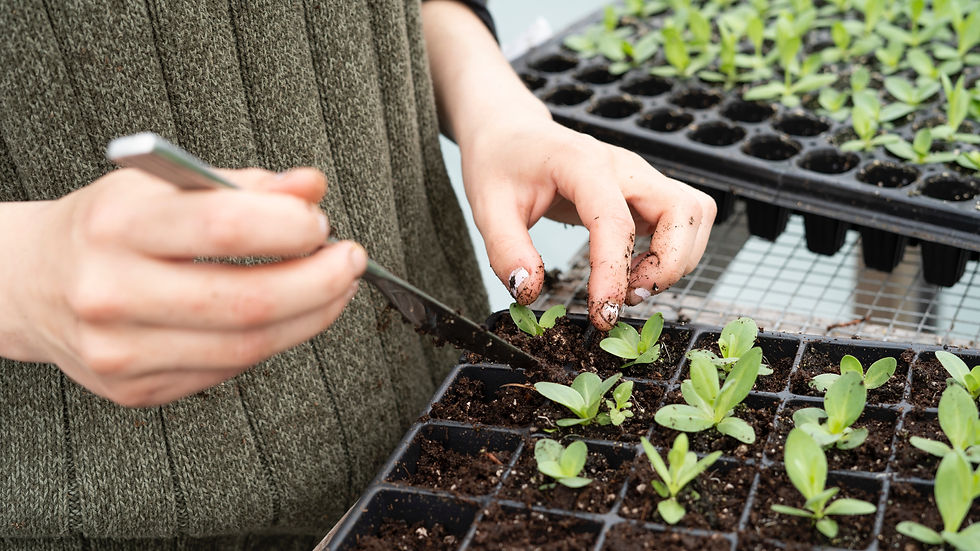
You can do everything right, and still lose a plant.
Weather changes. A late frost sneaks in. A pest shows up overnight. A plant that looked healthy yesterday just wilts without explanation.
Come onnnnnnnnn.
I asked the gardeners, "Gardening often involves unpredictable timelines—weather, seasons, growth cycles. When you feel behind or like things aren’t progressing as planned, how do you stay on track or adjust your approach?"
Darlene:
Unpredictable physical setbacks can play a role in adjusting: As I get older I tend to switch tasks during my work day so I’m not straining the same muscles all day long—prune a little, dig a little, kneel a little (pray)…and change my attitude/expectations.
Adjust my working time because I can’t tolerate when temps soar above the 80s. And sometimes when I miss a “gardening window” (pruning at the right time), it’s “Well, I’ll get to that next year.”
Carolyn:
Flexibility is key, there is always something to do in another area or on a different project. Lists and openness to revising the lists frequently, as well as, asking for help may be required and should be expected at times. Asking for help is often hard for me personally, but if you have a network of people who share similar passions, it makes it easier.
No matter how experienced you are, gardening means facing the reality that you’re not in total control—and you never were. You adapt. You replant. You take notes for next season. You mourn the failure *briefly.* You talk about it with community. And then you keep going.
Writers need to hear this, too.
You can plan the perfect writing schedule, set ambitious goals, and show up consistently — and still hit a block. Still get stuck in revision. Still get a “no” after pouring yourself into something. That doesn’t mean you’ve failed.
It means you’re in the middle of something that is alive.
This is the lesson: flexibility is not weakness, it’s wisdom.
So when your writing isn’t blooming the way you hoped—adjust the light! Give it more room. Pull a few weeds. Start again, if you must. But let go of the idea that control guarantees success.
Growth doesn’t follow a script. Neither should you.

Conclusion
Picture a seed. Any kind of seed. On the surface, it looks like nothing. Just a small, unremarkable speck. But, buried in the dark, with time, care, and the right conditions, it becomes a garden.
Ideas are like that, too! Drafts. Hunches. Maybe even a writer like you. Just...you know, go outside and get sunlight every once in a while.
Creative work doesn’t happen all at once and it doesn’t flourish under pressure. It needs space. It needs consistency. It needs patience. And most of all, it needs trust.
Trust that what you have planted will become something (even if you can’t see it yet).
So I encourage you: approach your writing the way a gardener approaches their work. Tend to it. Make room for growth. Let rest be part of the process. Don’t dig up the seed just because you’re anxious it’s not sprouting fast enough.
Trust yourself. Give it time. And remember: slow growth isn’t no growth. It’s the real kind.
🌼🌻🌼🌻🌼🌻🌼
What will you tend to today?
Katherine Arkady
Bonus: Here's a mini-game I coded while procrastinating the writing of this post 💚


Comments